



















 Lorem ipsum dolor sit amet, consectetur adipiscing elit. Cras consequat massa leo, eu euismod felis fringilla quis. Nullam felis tortor, facilisis vitae volutpat vel, fringilla nec nunc. Pellentesque feugiat tortor et risus faucibus, sed posuere dolor pharetra. Aliquam egestas dui eu velit egestas rutrum. Sed quam nisl, pulvinar non placerat ac, elementum eu mi. Donec enim nunc, vestibulum a arcu at, tempor fermentum magna. Nulla sit amet posuere massa. Vestibulum gravida porta interdum. Nunc vestibulum sem velit, eu adipiscing sem consequat ut. Maecenas tincidunt urna mi, et posuere nibh mollis nec. Nunc gravida eget orci id sollicitudin. Praesent eros turpis, gravida vel diam sit amet, lacinia tempus mi. Curabitur non enim ut tellus tincidunt aliquam sed vel sapien. Maecenas fringilla faucibus augue, non iaculis felis rhoncus non. Cras vitae eros vitae eros tristique dapibus. Cras vulputate vel est nec sagittis.
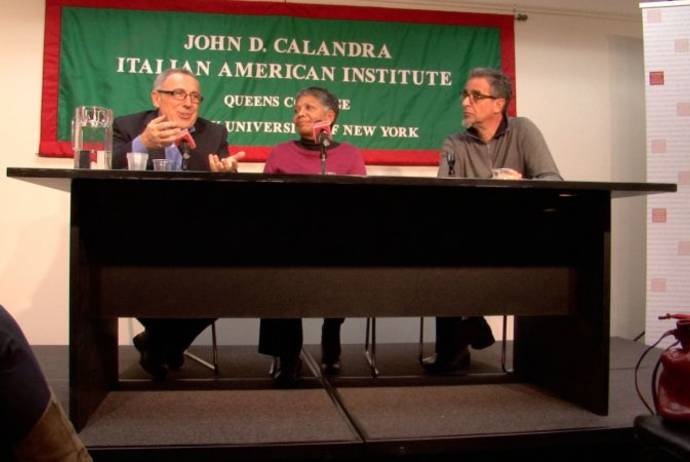
A few days after International Women’s Day, Casa Italiana Zerilli Marimò hosted a round table dedicated to women and politics. The conversation, opened by the director of La Casa Stefano Albertini, included the participation of Valeria Fedeli, Vice President of the Senate of the Republic, Lucina Di Meco (Gender & Leadership Consultant), Angela Vitaliano (Il Fatto Quotidiano) and Maria Luisa Rossi-Hawkins (TGcom, Mediaset).
The conversation occurred right after the Italian Parliament's recent rejection of the three amendments in the new electoral reform aimed at guaranteeing the equality of gender within public positions.
After a brief screening of a documentary that recalled 60 years of female presence inside Italian politics, Valeria Fedeli opened the debate commenting on what just happened in Italy.
“It is not a problem of laws. Italy has advanced laws but not well applied,” said the senator. Moreover, she explained that she was quite surprised, not about the rejection of the first two amendments, but about the rejection of the third one, which stated that both genders cannot be under-represented by 40% on the electoral lists. “ I thought this one could have been seen as an element of modern culture since its premises are definitely non discriminatory,” affirmed Fedeli.
According to the senator, there is a linguistic issue that contributes to this failure and “impedes to achieve our objectives.” “It’s wrong to talk about "Quote Rosa." It seems as something you need, because you know someone else holds the power,” said Fedeli. “I prefer to talk about rules. We need to set rules on the electoral laws.”
“I think there is a generational problem,” added Lucina di Meco. “Before, one thought that merit was everything. It’s not like that anymore. In Italy there is no meritocracy.”
Another big issue that was addressed during the conversation was the responsibility of the media in creating wrong models that are discriminatory especially for women. “We have many women who are very prepared and smart. But TV, for instance, gives more space to men, giving to women a secondary importance,” said senator Fedeli.
“It’s a socio-cultural problem that is reflected in the education system. The same educational contents are wrong, they don’t reclaim the historical role and importance of many women. We have to change the learning models, introducing, for example, sex education courses, which I like to call sentimental education, in order to hihglight to young people the existence of a relationship between men and women based on mutual respect for one another,” affirmed Fedeli.
At the end of the debate, together with Stefano Albertini, all the speakers went to pay homage to the victims of the fire that occurred at the Triangle Shirtwaist Factory on March 25th, 1911, that caused more that 140 deaths, of which 123 were women.